
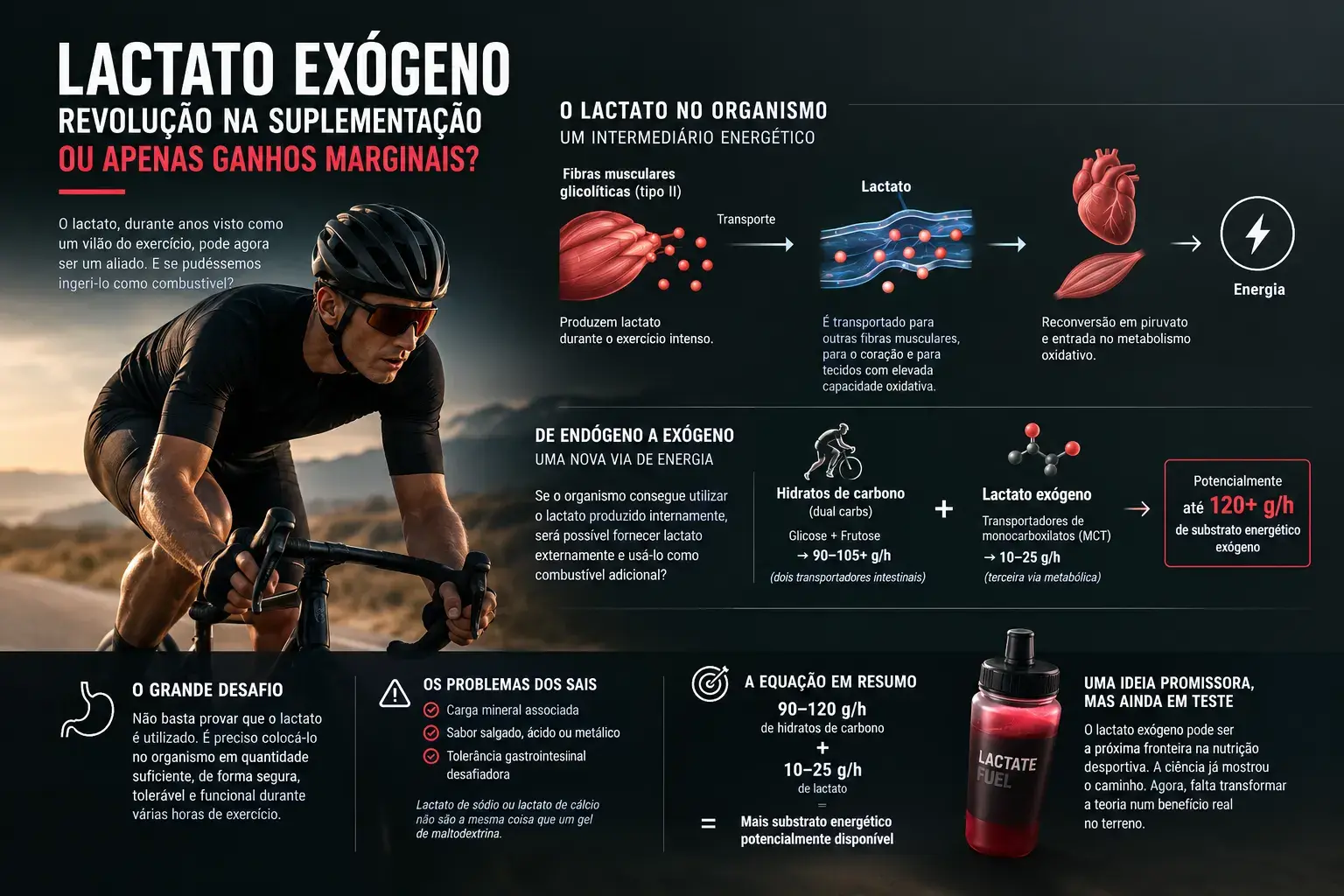
For decades lactate was treated as one of the great villains of exercise physiology. Tied to the burn in the legs, to fatigue and to the inability to keep producing power, it became almost synonymous with maximal effort. We now know that reading was far too simple. Lactate is not merely a waste product: it is a highly dynamic metabolite, produced, transported and reused by the body as fuel.
Which is exactly where one of the more interesting — and potentially more controversial — ideas in sports nutrition sits today: what if, instead of only producing lactate during exercise, we could also drink it as fuel?
Lactate is not the villain of fatigue
The first thing to clear up is that lactate is not the direct cause of muscular fatigue. During hard exercise glycolysis ramps up and more lactate and H⁺ ions are produced. It is the disturbance of acid–base balance, among other factors, that eats into contractile capacity and raises the sense of effort. Lactate itself should not be treated as the “waste” that makes you blow up.
In practice the more glycolytic fibres — particularly type II — can produce lactate in large amounts. That lactate is shipped out of those fibres and taken up by tissues with a high oxidative capacity, including more oxidative fibres and the heart. There it can be converted back to pyruvate and enter oxidative metabolism. What was read for decades as metabolic waste is, in reality, an extremely dynamic energy intermediate.
A third door beside carbohydrate
The real innovation is now the question: if the body can use lactate it produces itself, can we supply it from outside and use it as extra fuel? That is exogenous lactate.
The logic sits neatly next to how carbohydrate intake has evolved in cycling. For years 60 g/h was considered a lot. Well-adapted endurance athletes now routinely take in around 90–120 g/h, mostly by pairing glucose and fructose. The limit is not “how much sugar fits in the bottle”: it is the gut’s ability to oxidise carbohydrate, which depends on intestinal transporters. A single source (glucose) tops out around 60 g/h; glucose and fructose use different transporters, which is why dual-carb strategies push the ceiling to 90–105+ g/h.
Lactate theoretically opens a third door: it can move through monocarboxylate transporters, a different route from traditional carbohydrate. The hypothesis is elegant: 90–120 g/h of carbohydrate + roughly 10–25 g/h of lactate = more exogenous energy substrate potentially available. If that works efficiently, it is not just “more sugar in the bottle”.
The practical problem: delivering the lactate
Showing that lactate can be used metabolically is not enough. It has to be put into the body in a useful amount, safely, tolerably, and for hours on the bike. Lactate is traditionally supplied as salts — sodium or calcium lactate — and drinking large amounts of those salts is not the same as a maltodextrin gel. There is a mineral load, the taste can be salty, acidic or metallic, and gastrointestinal tolerance quickly becomes the bottleneck.
In one study (Bordoli et al.) riders showed favourable changes in acid–base balance and a lower rating of perceived exertion, but no performance improvement — and there were GI side effects. That is why the industry is exploring lactate esters, hydrogels, polymers and micro-encapsulation. The question is no longer only whether lactate “works”, but whether we can deliver it for hours without turning the race into a fight with the stomach.
Revolution, or a marginal gain?
The research is interesting, but it is still small and inconsistent. One of the more cited papers is Ewell et al. (2024): 15 recreational athletes, double-blind, randomised, crossover. The lactate supplement did not change VO₂peak, VO₂ at the ventilatory threshold or power at lactate threshold. In a 20-minute time trial, average power went from 197 to 204 W — about 4%. The difference was statistically significant, but we are talking about 15 recreational participants and one specific 20-minute test. Eleven improved; four got worse. Those 4% are not a promise of “4% extra performance”.
There is contrary evidence. In Bordoli et al., 16 trained cyclists took 120 mg/kg of lactate before a protocol of about two hours with repeated high-intensity efforts (around 4.2 g/h for a 70 kg rider). Lactate raised bicarbonate and lowered perceived effort, but there was no significant performance gain. Feeling less effort is not the same as producing more watts. Metabolism can shift, acid–base balance can improve, RPE can drop — and the clock can stay exactly where it was.
The pro peloton is not evidence
Interest in lactate exploded once it started showing up in the professional peloton. In 2026 UAE Team Emirates-XRG confirmed using a drink with exogenous lactate at the Tour de France, combining sodium lactate and carbohydrate, selectively — not as a universal tactic. The media impact is obvious. So is the gap between a WorldTour team trying something and that something being a proven ergogenic strategy.
Practitioners working with pro nutrition programmes still point out the missing pieces: how much lactate actually makes it through the gut, what it does to plasma lactate, and — above all — the real effect on elite performance. That is exactly what we should want to see before calling anything a revolution.
The amateur rider sits somewhere else on the pyramid
Picture an amateur in a four-hour event, FTP 240 W, training three unstructured days a week, missing weeks, not managing recovery, taking in 50–60 g/h of carbohydrate during the race. Is that rider’s main problem the missing 10–25 g/h of lactate? Almost certainly not.
A rider who goes from inconsistent training to 40–50 structured weeks a year can raise physical capacity substantially: FTP, VO₂max, threshold power, economy, fatigue resistance. Moving from 90 to 120 g/h of carbohydrate — or adding lactate — does not magically rewrite physiology. It can help you reach the last hour with more fuel left, reduce the fade and improve recovery. That is optimising capacity that already exists. Training is what builds that capacity.
If a rider lifts FTP from 250 to 280 W, that is a 12% improvement in sustainable power. If a better fuelling strategy lets them hold an extra 5–10 W in the last hour, that is a very different kind of gain. Both matter; they are not equivalent. Training compounds. 120 g/h does not raise FTP, does not directly raise VO₂max, does not build mitochondria, does not improve pedalling economy.
For the amateur the order is still: consistent training, enough volume, progression, time-in-zone, recovery, nutrition — and only then supplements and specific optimisations (kit, bike weight, a new molecule). Race nutrition matters. There is a difference between not underestimating it and overvaluing a new nutritional technology.
Moving from 60 to 90 g/h of carbohydrate can be very relevant in a 4-, 5- or 6-hour event. Even then, if a rider goes from 90 to 120 g/h and finds 1–3% in an experimental setting, that is an interesting gain, not a transformation. At 300 W, 3% is about 9 W: enormous in the pro peloton, often easier for an amateur to find through a better training process. And if the rider is currently at 40–50 g/h, getting to 70–90 g/h and learning to tolerate carbohydrate has a far better benefit-to-complexity ratio than jumping straight to 120 g/h + lactate.
This is not a revolution yet
This is not a revolution yet. That does not mean exogenous lactate is useless — on the contrary, it is one of the more interesting ideas in sports nutrition right now. The science of lactate metabolism is solid, the physiological hypothesis is elegant, and a fuel pathway that is not glucose/fructose is genuinely interesting. But the distance between a plausible mechanism, a metabolic change and a consistent performance improvement is large. That last step is not yet well demonstrated.
We have one study with about 4% in a 20-minute time trial, another in trained cyclists with acid–base changes and lower RPE but no performance gain, an industry building more sophisticated formulations, and professional teams trying it in races. That justifies research. It does not justify certainty.
The most credible position today is that exogenous lactate will end up being useful, but probably not in the near-revolutionary way some campaigns suggest. Perhaps 5–10 g added to a 90–120 g/h carbohydrate strategy produces a small benefit in specific contexts. Perhaps elite riders, who have already wrung most of the available gains from training, can extract value from improvements that would be almost irrelevant for an amateur.
The next big revolution in amateur cycling is unlikely to be a new molecule. It is more likely to be doing, for 40–50 weeks a year, the much less glamorous work: training consistently, managing load, recovering, eating properly, and repeating it. Exogenous lactate may yet add a thin layer at the top of that pyramid. Right now the evidence does not justify putting it at the base.
For now, I would take the watts built in training.